
Next Ensemble Presents:
Brass
At The Botanical Gardens

Tonight's Performers
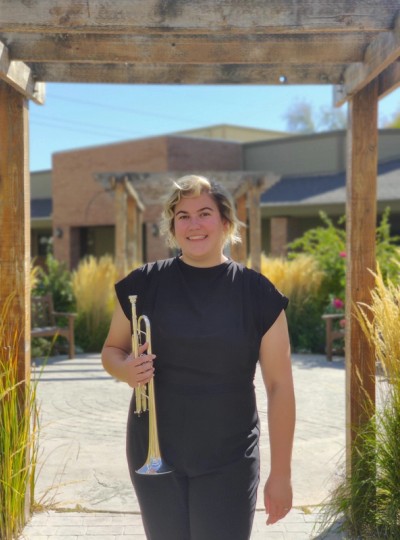
Tayler Duby
Tayler Duby is a freelance performer and educator based in Salt Lake City, Utah. She holds a Master’s degree in Trumpet Performance from the University of Utah and a Bachelor’s degree in Music Education from the University of Nevada-Reno. Tayler finds great joy and fulfillment in innovative performance and teaching practices.
Tayler is currently the Adjunct Professor of Trumpet at Salt Lake Community College and she performs with several local ensembles, including the Canyons Brass Quintet, Salt Lake Symphony, Salt Lake Choral Artists, and Draper Philharmonic & Choral Society. She performed as Principal Trumpet with the Hart Theater Company in their 2024 world premier of Hope for the Flowers, as well as Second Trumpet with The Grand Theatre in their 2025 production of Dreamgirls. She has also excelled in numerous local and national competitions, notably achieving the title of National Finalist in the 2022 MTNA Young Artist Brass Competition.
In addition to her performing career, Tayler is passionate about music education. She recently completed a two-year Graduate Teaching Assistant position, in which she developed her college teaching skills, with the University of Utah Marching Band. She has conducted several clinics and masterclasses in high schools across Utah, Nevada, and northern California, enriching young musicians' skills and knowledge. Tayler also enjoys arranging music for solo instruments and chamber ensembles, as well as recording and editing music.

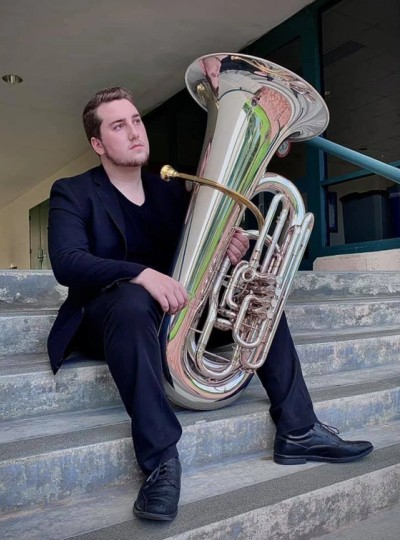
Joel Horton
Joel Horton is in his first year pursuing a DMA in Tuba performance at the University of Utah. He is from Waco, Texas and holds a Bachelor of Music in Tuba Performance from the University of Miami where he studied under Aaron Tindall and a master’s degree from the University of Washington. He is a substitute musician for the Academy of St. Martin in Fields, Seattle Symphony Orchestra, Seattle Opera, Baltimore Symphony Orchestra, Northwest Sinfonia, Sammamish Symphony Orchestra, Utah Symphony, and the New World Symphony. Some of Joel’s honors include being a Semi-Finalist in the Artist Division Semi-Finalist Leonard Falcone International Festival Solo Competition in 2022, Semi-Finalist in the ITEC Arnold Jacobs Mock Orchestra Tuba Competition in 2023, Winner of the NWRTEC Mock Orchestra Competition in 2024, and Runner Up NWRETC Tuba Artist Division Solo Competition in 2024. Joel was awarded a Brevard College Institute Fellowship in 2023 and 2024 where he spent both summers giving recitals and playing in the college and faculty orchestras. In 2025 Joel will continue studying at the University of Utah and freelancing in Salt Lake City, Utah.

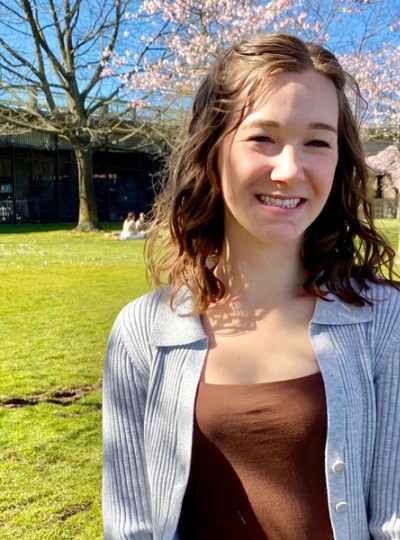
Mya Scheib
Mya is a multifaceted scholar and musician currently pursuing a Ph.D. in the Department of Genetics at the University of Utah. With a Bachelor of Science in Biology and a Bachelor of Arts in Music from the University of Kentucky, Mya brings a unique blend of scientific rigor and artistic passion to her pursuits. Mya's research focuses on muscle stem cells and skeletal muscle regeneration. Her work is driven by a curiosity about how these cells contribute to the repair of muscle after various traumas, with implications for medical advancements in regenerative medicine. Alongside her academic endeavors, she remains deeply connected to her musical roots. As a talented French horn player, Mya actively participates in orchestral and chamber groups, channeling her creativity and musicality into collaborative performances.

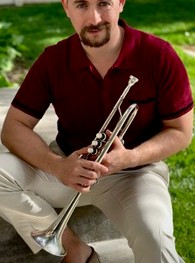
Mike Sullivan
Michael Sullivan is a versatile and dynamic trumpeter, praised by Maestro Bramwell Tovey for his lyrical yet powerful style and “exquisite musical instinct.” Equally at home in orchestral, chamber, and commercial settings, Michael brings depth and artistry to a broad range of musical idioms.
As a freelance artist in Los Angeles, Michael performed with studio musicians in the Southeast Symphony and appeared as a soloist with the CSU Long Beach Brass Ensemble, performing Anthony Plog’s Concerto No. 2 for Trumpet and Brass Ensemble. He has also served as principal trumpet of the Puget Sound Symphony and performed with the Cape Ann and Waynesboro Symphonies. He was a frequent guest artist with the UVA Faculty Brass Quintet and is a two-time semi-finalist in the National Trumpet Competition’s graduate solo division.
Currently based in Salt Lake City, Michael is the principal trumpet of the Salt Lake Symphony and a founding member of the SB Collective Ensemble. Since summer 2024, he has also been a member of the Canyons Brass Quintet. His experience as an educator includes serving as a clinician at the prestigious BU Tanglewood Institute and as a soloist and clinician for the Palomar College Brass Ensemble.
Michael holds both Bachelor’s and Master’s degrees in Trumpet Performance from CSU Long Beach, where he studied under Rob Frear and Christopher Still (Los Angeles Philharmonic). He pursued post-graduate studies at Boston University with Terry Everson and attended the renowned Chosen Vale Trumpet Seminar, where he worked with Tom Stevens and Håkan Hardenberger.

Bjorn Swanson
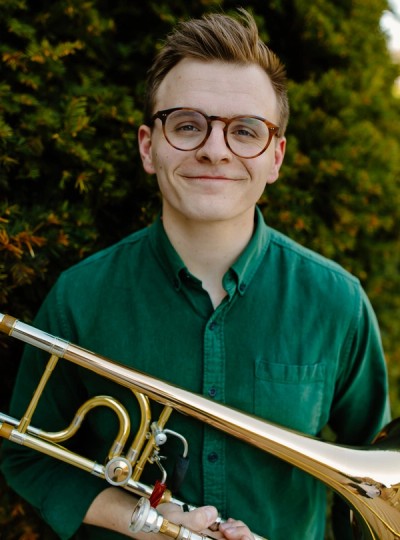
Bjorn Swanson is a trombonist and music educator based in Salt Lake City, Utah. Bjorn has previously taught at the University of Utah as an adjunct faculty member and graduate teaching assistant, working extensively with the department of athletic bands, serving as an assistant director of athletic bands for the past two years, and the music education area. Bjorn has performed and presented at several conferences and festivals around the country, including the International Trombone Festival, CBDNA Conference, and the Utah Music Educators Association Conference.
Bjorn is also an advocate of brass chamber music, founding the brass ensemble, Canyons Brass Quintet, and the Utah Chamber Brass Collective at the University of Utah in the fall of 2022. Since its founding, the Utah Chamber Brass Collective has performed multiple recitals including a residency featuring the brass ensemble, Mirari Brass Quintet.
Bjorn received his Bachelor's of Music in Performance and Bachelor's of Arts in Music Education from the University of Iowa in 2020, and his Master's of Music in Instrumental Performance from the University of Utah in 2023. His primary instructors are Dr. Jonathan Allen, Dr. Donn Schaefer, Mark Davidson, and his grandfather Dr. Thomas Swanson.

Program Notes
"Fossils" from The Carnival of the Animals
Camille Saint-Saëns composed his whimsical Carnival of the Animals in 1886 as "a piece of fun," forbidding its public performance during his lifetime to protect his reputation as a serious composer. The "Fossils" movement presents a brilliant musical joke: Saint-Saëns quotes melodies that were already considered ancient in his time, including his own Danse Macabre, "Twinkle, Twinkle, Little Star," French nursery rhymes like "Au clair de la lune" and "J'ai du bon tabac," the patriotic "Partant pour la Syrie," and even Rossini's "Una voce poco fa" from The Barber of Seville.
The Bill Holcombe arrangement for brass quintet faces the unique challenge of translating the original's prominent xylophone part—meant to evoke clattering bones in a midnight museum—into brass textures. Saint-Saëns' self-deprecating wit appears immediately as he quotes his own Danse Macabre from just twelve years earlier, suggesting even his recent works had become "fossilized." The movement's two-minute duration packs in musical archaeology: melodies appear sometimes inverted (as with "J'ai du bon tabac" played upside-down), creating layers of sophisticated humor that delighted Franz Liszt at an early performance where musicians wore skeleton masks.
Blue Pavilion
British composer Dani Howard (b. 1993) has rapidly emerged as one of classical music's most exciting new voices. Winner of the 2022 Royal Philharmonic Society Award for her Trombone Concerto, Howard studied at the Royal College of Music and now creates works performed by major orchestras worldwide. Critics praise her "luminous and effervescent sound world" characterized by flowing ostinatos and sophisticated orchestration that remains accessible to audiences.
Blue Pavilion is an original work for brass quintet lasting approximately 5 minutes and 30 seconds. The piece demonstrates Howard's characteristic compositional style: tonal harmonies enriched by churning rhythmic ostinatos, unexpected harmonic shifts, and ear-catching instrumental colors. Like much of Howard's chamber music, the work likely features her signature technique of building complex textures from simple repeated patterns that gradually transform and interact. Her brass writing typically exploits the full dynamic and timbral range of the instruments—from whispered muted passages to brilliant fanfares—while maintaining the melodic appeal that has made her music internationally celebrated. The title suggests architectural imagery, possibly evoking the interplay of light and shadow through contrasting brass sonorities and the spatial effects created by antiphonal writing between the quintet members.
"Venus, the Bringer of Peace" from The Planets
Gustav Holst's The Planets (1914-1917) drew inspiration from astrology rather than astronomy, with Venus representing peace, harmony, and fortune. The movement opens with a solo horn theme in E-flat major that unfolds over gently rocking accompaniment figures, creating what critic Michael Short called "one of the most sublime evocations of peace in music." Holst allowed himself rare romanticism here, particularly in the famous oboe solo that his daughter Imogen described as providing "the right answer to Mars." The movement's transparent orchestration features delicate harp glissandos, muted strings, and celesta, building to a luminous climax before dissolving into tranquil silence.
The R.A. Jones arrangement for brass quintet faces the formidable challenge of redistributing the original's ethereal string tremolo and woodwind passages among brass instruments. This brass quintet version employs extensive mute usage—straight mutes for the opening horn solo, cup mutes to simulate distant effects, and careful dynamic control to maintain the movement's meditative character. The famous oboe melody typically passes to flugelhorn or muted trumpet, while the trombone and tuba must execute the rolling accompaniment figures with exceptional delicacy, proving that brass instruments can whisper as beautifully as they proclaim.
Motivic Moments
Drew Phillips composed Motivic Moments in 2013 for the International Low Brass Trio, a chamber ensemble based in San Francisco, California. The work received its premiere on October 15, 2013, at the San Francisco Conservatory of Music, performed by hornist Jeff Dittmer, trombonist Gabe Cruz, and tubist Jess Rodda.
Phillips describes his composition as featuring "five movements, several of which are seamless in performance." The work's architecture centers on a single motive first presented by the horn in the prelude, which then undergoes transformation throughout the piece in what the composer calls "short, stylistic moments." This motivic development technique—where a small musical idea generates an entire composition—connects to the great tradition of composers from Beethoven to Brahms.
The work's most distinctive characteristic is its "vast amount of syncopation and layering throughout the piece." This rhythmic complexity creates a contemporary sound world while maintaining accessibility through the clearly audible motivic connections. By writing specifically for this unusual low brass combination, Phillips explores the rich harmonic possibilities when horn, trombone, and tuba blend their distinctive timbres in various registers.
"Blue Bells of Scotland"
This beloved Scottish melody, composed by actress Dora Jordan around 1801, has traveled far from its folk origins. The simple tune in 6/8 meter tells of a Scottish soldier's departure for war, with its characteristic dotted rhythms evoking the lilting quality of Scottish folk music. The song gained new life through Arthur Pryor's famous 1899 trombone solo arrangement, which transformed the simple tune into a virtuosic theme and variations showcasing the full technical and expressive range of the instrument.
Pryor's arrangement typically includes an introduction, the theme, and multiple variations that progressively increase in difficulty—featuring rapid triple-tonguing passages, dramatic glissandos, pedal tones, and soaring melodic lines that extend into the altissimo register. Modern brass quintet arrangements, including versions by Andrew Poirier and others, ingeniously distribute these solo passages among all five players, creating a collaborative showcase. Each instrument takes turns with variations suited to its character: the trumpet might execute brilliant fanfare-like passages, the horn explores lyrical middle variations, the trombone pays homage to Pryor with glissando-filled variations, while tuba variations often feature surprising agility in rapid passages. This democratic approach transforms a solo vehicle into a celebration of the entire brass family's capabilities.
Brass Quintet, Op. 65
Dutch composer-conductor Jan Koetsier (1911-2006) devoted much of his creative life to elevating brass chamber music to serious artistic status. After distinguished tenures with the Amsterdam Concertgebouw Orchestra and Bavarian Radio Symphony Orchestra, Koetsier composed prolifically for brass, stating: "The attraction to the brass is inscribed throughout my entire work."
His Brass Quintet, Op. 65 (1974) demonstrates this mastery across three movements totaling approximately 11 minutes and 30 seconds. The composer himself described the work's character: the first movement (Andante con moto - Allegro con brio, 3'45") revels in rhythmic complexity with "many changes of meter and shifted accents," creating an energetic dialogue where instruments trade syncopated patterns. The second movement (Andantino, 3'45") contrasts a "simple, melodious phrase of the trumpet" with a "burlesque theme from the tuba," which undergo variations before reuniting "in a choral manner at the end"—showcasing Koetsier's gift for characterful writing. The finale (Molto vivace, 4'00") showcases the ensemble's virtuosity in a vigorous 6/8 meter "interrupted only by a few obstinate 7/8 meters," demanding both technical precision and ensemble cohesion.
Premiered by Concertgebouw Orchestra brass principals in Straubing, Germany, this quintet has become a cornerstone of the repertoire, representing Koetsier's belief that brass instruments deserve music of the highest artistic caliber.
"Make Our Garden Grow" from Candide
Leonard Bernstein's Candide (1956) concludes with this profound meditation on finding meaning through simple, honest work. After experiencing war, disaster, and human cruelty throughout Voltaire's satirical tale, the naive Candide and his companions abandon grand philosophical theories for practical living: "We're neither pure, nor wise, nor good / We'll do the best we know / We'll build our house and chop our wood / And make our garden grow."
The Chris Dedrick arrangement for brass quintet transforms Bernstein's choral finale into a showcase for brass instruments' ceremonial warmth. Dedrick (1947-2010), a founding member of The Free Design and key creative force behind many Canadian Brass performances, crafted a technically demanding yet emotionally powerful arrangement. The piece begins intimately in B-flat major with a simple hymn-like texture, gradually building through modulations and increasingly complex counterpoint. The first trumpet navigates particularly challenging high passages (often reaching written high C and above), while inner voices weave intricate harmonies that reflect Bernstein's sophisticated jazz-influenced voice leading. The arrangement's climax features all five instruments in glorious counterpoint before returning to the simple dignity of the opening—suggesting that through mutual care and authentic work, we can create beauty in an imperfect world. This transformation from intimate reflection to triumphant affirmation showcases the brass quintet's unique ability to combine chamber music subtlety with orchestral grandeur.
Finale from The Carnival of the Animals
Saint-Saëns brings his entire zoological cast together for a "whirlwind of activity" in the Carnival's finale. Opening with the same tremolo piano passages that began the suite, the movement quickly develops into what the composer called "a frolicking ballet-style finale." The music recalls themes from earlier movements in rapid succession—the lion's royal march, the wild jackasses' galloping scales, the kangaroos' hopping rhythms, and the hens' pecking motifs—creating a musical parade that resembles a 19th-century traveling carnival.
The movement's structure follows a modified rondo form (A-B-A-C-A-coda), with the main theme's bouncy 2/4 meter providing unity while episodic recalls of the animals create variety. In the Bill Holcombe brass quintet arrangement, the challenge lies in maintaining clarity while juggling multiple thematic fragments that often overlap in counterpoint. The arrangement must also capture the original's orchestral colors: string tremelos become rapid repeated notes in the trumpets, woodwind flourishes translate to horn and trombone passages, and the piano's glissandos might appear as trumpet shakes or trombone slides. The famous ending features the donkeys' "hee-hawing" motif (a descending octave leap followed by a grace note) passed between instruments before a brilliant C major conclusion—proving that Saint-Saëns saved his best joke for last.